Artistic Activism During the Iraq War: Merely Protest Cardboard? or Artistic Masterpieces?
During the first semester, I wrote an essay on Kennardphillips’ Photo Op, exploring the photomontage protest art against the Iraq war of 2003. My research for the essay exposed my understanding to the extreme volume of protest art that was created in opposition to the 2003 Iraq war.
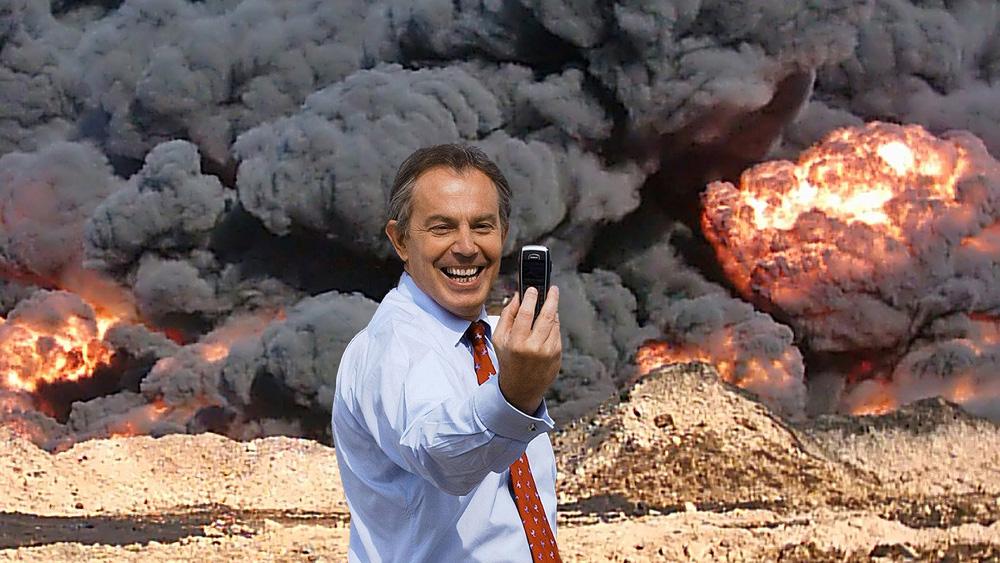
Blair’s decision to join the USA in their decision to go to war with Iraq was totally rash. His failure to ignore some of his closest advisors, and ignorance towards the protesting public voices truly question his ethnic rule. The supposed links with 7/7 bombings also embody the lack of understanding that Blair had of the war’s consequences on Britain’s security, let alone the hundreds of casualties during the war itself.
I found it fascinating to see how this invasion sparked an uproar of creative opposition as the Government ignored vocal protests. A London protest in 2003 saw one million people take part in one of the most visually striking protests ever to have taken place in the UK. Featuring many war posters, graphic designers were toying with words, such as ‘make tea not war’, to blame Bush and Blair for the unnecessary conflict. Posters were becoming weapons on the home front, produced to spark a reaction, many were unaware they were producing masterpieces.
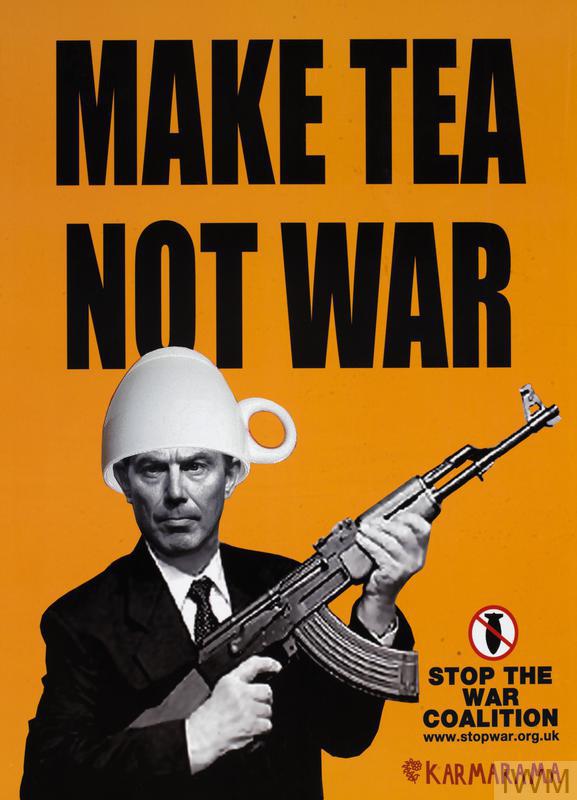
Make Tea Not War, Karamarma and STWC, 2004, Available at: https://www.iwm.org.uk/collections/item/object/14563 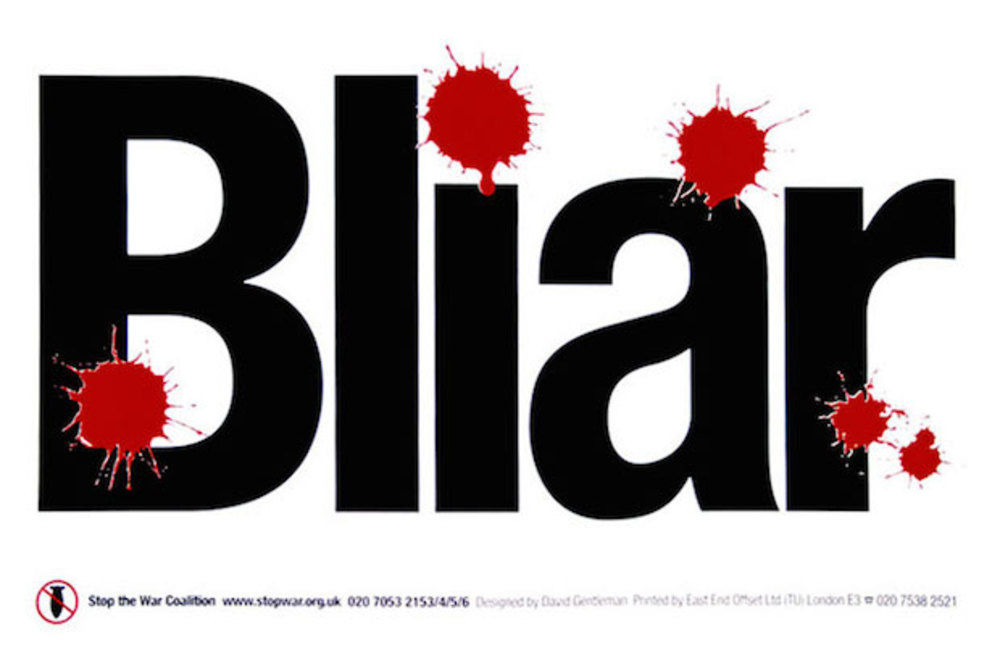
Blair, David Gentleman, 2003. Available at: https://www.grafik.net/category/feature/david-gentleman 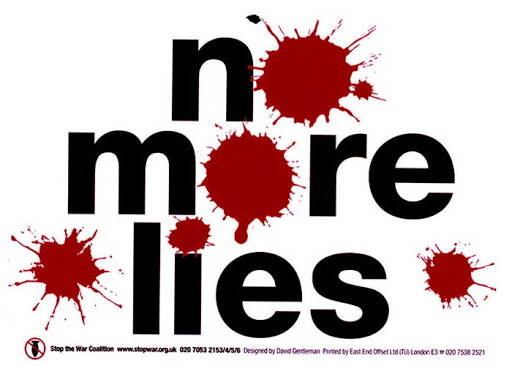
No More Lies, David Gentleman, 2003. Available at: https://www.grafik.net/category/feature/david-gentleman 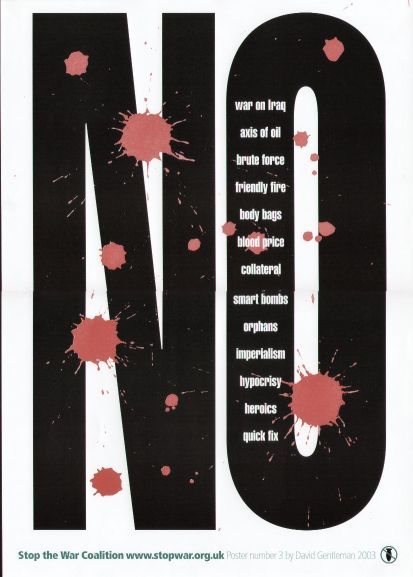
NO, David Gentleman, 2003. Available at: https://www.grafik.net/category/feature/david-gentleman
On the other hand, Brian Haw was an avid protester who became an iconic visual symbol for Britain’s frustration at Tony Blair. Understanding the depth of his silence creative posters, Mark Wallinger produced, State Britain, 2007: a homage to Haw. Held at the Tate, hence ironic “state” title to criticize the Government, he challenged how such a passionate piece of artistic protest could be redefined as an exhibition piece.
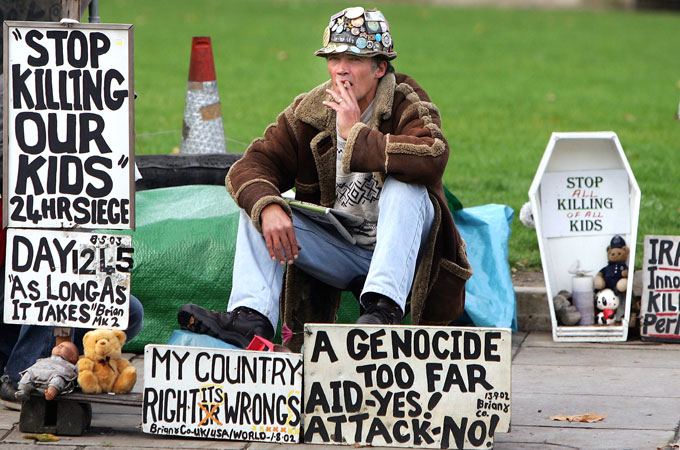
Wallinger raises interesting questions surrounding the power of art as a method of protest. Indeed, at the time, Haw’s may have not consciously been aware that he was producing art through his protest. However, by being placed in an exhibition space through Wallinger’s recreation, an audience pauses to acquire a deeper understanding of Haw’s cardboard pieces. Trying to engage with the movement, the location of protest art can totally redefine the strength of its organic emotion.
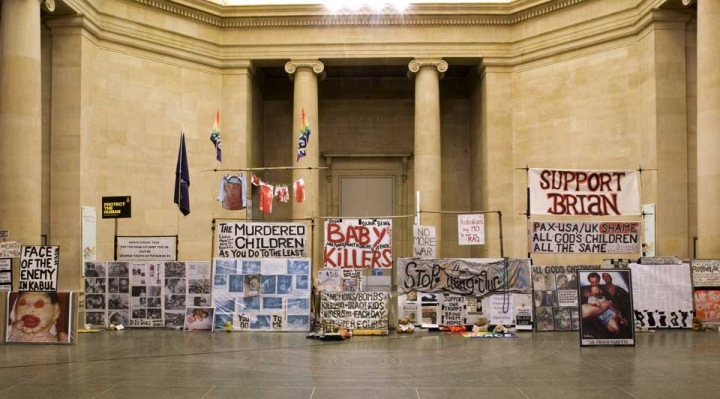
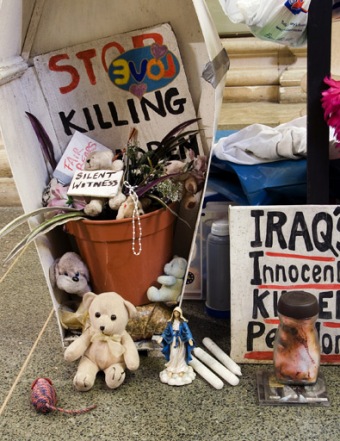
I personally really like the challenges raised by Wallinger in State Britain. Alongside the public anger against Blair, the piece truly embodies how art was being pushed in another direction of active protest to visually speak a thousand words.
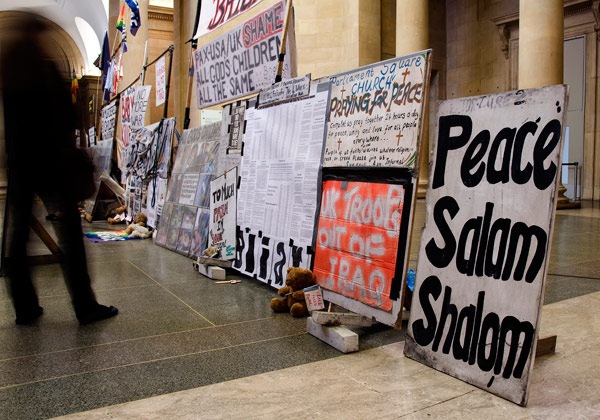
I find it infuriating how Blair refused to listen to the thousands of protestors. It really made me think about the legitimacy of a democracy and how political relationships can overtake how a country is run.
Exhibitions
Museum of Modern Art
The Gluf Wars: https://www.moma.org/calendar/exhibitions/5084
Protest Documentaries From London 2003
Bibliography
Aulich, J. (2007). War Posters: Weapons of Mass Communication. Thames & Hudson, United Kingdom.
BBC News. 2011. Peace Campaigner Brian Haw Dies. [online] Available at: <https://www.bbc.co.uk/news/uk-13828800> [Accessed 17 March 2020].
BBC News. 2003. ‘Million’ March Against Iraq War. [online] Available at: <http://news.bbc.co.uk/1/hi/uk/2765041.stm> [Accessed 10 January 2020].
Bois, Y., Brett, G., Iversen, M. and Stallabrass, J., 2008. An Interview with Mark Wallinger. October, 123, pp.185-204.
Daddow, O. (2009). ‘Tony’s War’? Blair, Kosovo and the Interventionist Impulse in British International Affairs. The War over Kosovo: Ten Years On, Vol. 85, No. 3, pp. 547-560.
Downey, Anthony., 2014. Art and politics now. Thames & Hudson.
Bluth, C. (2004). The British Road to War: Blair, Bush and the Decision to Invade Iraq. International Affairs (Royal Institute of International Affairs), Vol. 80, No. 5, pp. 871-892.
McQuiston, L., 2015. Visual Impact. Berlin: Phaidon, pp.110, 112, 128, 129.
Rai, M. (2006). 7/7: The London Bombings, Islam & The Iraq War. Pluto Press, London.
Tate. 2007. Mark Wallinger: State Britain: Duveens Commission – Exhibition At Tate Britain | Tate. [online] Available at: <https://www.tate.org.uk/whats-on/tate-britain/exhibition/mark-wallinger-state-britain> [Accessed 17 March 2020].
Wallis, C., 2015. ‘State Britain’, Mark Wallinger, 2007 | Tate. [online] Tate. Available at: <https://www.tate.org.uk/art/artworks/wallinger-state-britain-t14844> [Accessed 19 March 2020].
 Hattie Abbott : SAB935 Creative Dissent